Signals and communication
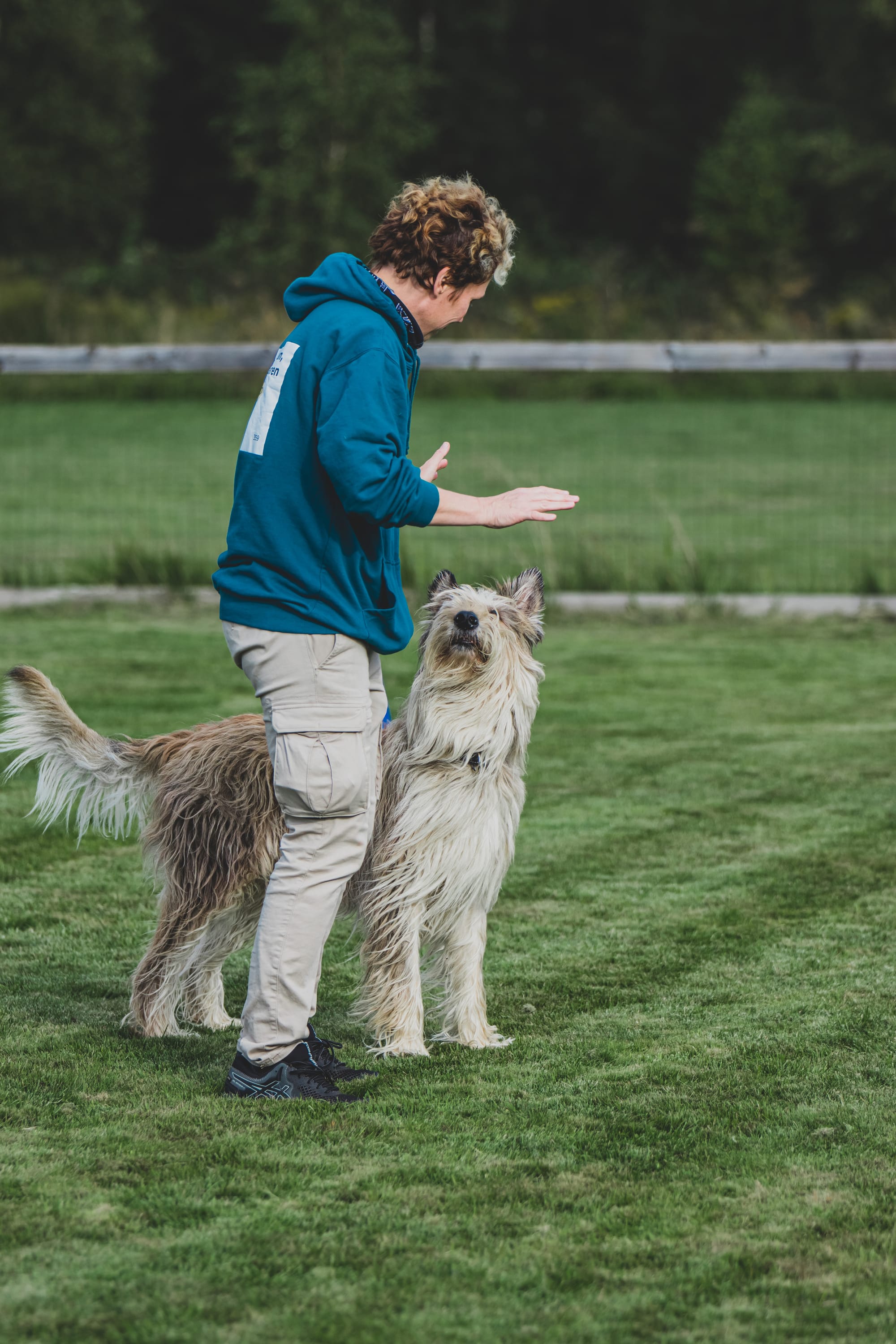
Communication is the sharing of information between two individuals. In dog training we somehow manage to be all for communication while at the same time being incredibly tight-fisted with information. We much rather will tug the leash instead of telling the dog where to go. Corrections and physically moving the dog where we want them to go are of course some form of communication, too. But I like to think of information as signals that both parts actually understand.
In the same way that dogs were bred to cooperate with us, human beings who were good at cooperating with dogs must have had an evolutionary advantage. We are literally made to understand each other so we should use that skill more than we do.
Thanks for reading Jana’s thoughts on dog training! Subscribe for free to receive new posts and support my work.
This not only goes for newbies who rather use a tug on the leash to change the dog’s pace or direction instead of signaling using body language or words. This also affects competition handlers who won’t give the dog the extra info needed to do the exercise perfectly. I don’t know where that comes from, but have a suspicion that it may derive from obedience trials where it seems to be considered best when the dog knows the program by heart. The fewer signals the handler gives, the better the marks. I don’t know if that’s true, but from the little I have competed in obedience and from the rules I’ve read that seems to be the case. I think it’s a little weird to try to train cooperation with the aim to cut down on communication, so I feel more comfortable with rally obedience or agility, where you are allowed to signal as much as you like. The first sentence in the Swedish rally-o rules is that the sport is about fun, communication and cooperation. It is stated in the first paragraph that the handler is unlimited in his communication with the dog and that’s what I strive for even in everyday life.
At the same time, communication should work the other way, too. In many situations we are quite inept at understanding our dog’s language: competition handlers not noticing that the dog is uncomfortable in the ring, experienced dog owners not realizing that the dog is stressed, interpreting the dog’s fidgeting as happiness, the list is endless. Explaining the body language of dogs is a whole book in itself so I’m not going into that today, but might take up some of the most important things to watch out for another time. Or just order Barbara Handleman’s illustrated book on canine behavior. There are Swedish and German translations available.
For now I will limit myself to a list of words that are not commonly taught in puppy class, but which I have found really useful. These can be signals I taught as a trick or as an exercise for competitions and can now use in different situations or words and phrases my dog has learned by just listening (repetition).
One, and another one
I just kept saying this in order to keep him in the game with bigger rewards and it means literally that there are more treats on their way. It’s important to pay the dog according to the amount of effort the dog has put into a task. So not only do I want to reward him longer when he has been working for some time, but I also want him to understand that I won’t stop rewarding him after the first treat.
This has turned out to be one of the most useful phrases ever. I think he understood it quite fast, because rewards nowadays are important to him. The reason I actually know that he has understood the meaning is an issue he has had with nail dremeling. After years of training he likes to have his nails done (more on that in future posts), but he is more inclined to offer his left front paw. I rarely get to do the right one, which he is a bit concerned with after a few nail injuries on that side. So I told him that would get more rewards for the right paw by pointing to it and saying “One, and another one”. He immediately offered the right paw and didn’t once offer the left one afterwards. He is not an idiot and obviously will go for two treats instead of one every time.
I’ve lately been using that phrase more often and it totally works for keeping him in the game, when he can’t get treats right away. I had to use crutches for a few weeks in spring, which made it a little awkward to get the treats out. There was also a bitch in heat in the household, which meant that Moril had a tendency to veer off and get stuck in places where she had been. Crutches also mean that a leash is impractical so I had to load up with the really good treats. Most times he gladly comes when called, but with a crutch in each hand I was far to impatient to stop every single time to reward him. Normally he would check out after not being rewarded for two or three times, because “his bitch” in heat is far more important than I am. So we were counting treats on our way to the car. Every time he responded to some signal I counted in “another one” and since he also knows the phrase “Get in the car” he knew that he would get loads of treats when we reached the car. That kept him on course and was a nice workaround when I didn’t have my hands free.
That’ll hurt
After countless times likening grooming to a human dentist appointment I started to think about what makes me more comfortable at the dentist’s. We had an amazing dentist a few years back, who not only rewarded us with treats (“You will get a discount if you allow me to fix that hole right now.”), but who also was incredibly good at explaining what he was about to do. He used to count down the seconds he would drill, if he thought the drilling might hurt. That made drilling so much more bearable that I adopted a version of this when treating minor dog injuries. If I think that something will hurt, I just tell Moril up front. In the same way that I felt more in control at the dentist’s, he can settle down the rest of the time when it obviously won’t hurt. He is more relaxed that way and seems to trust me a little more in grooming.
Come on!
This or something like this is a fairly common signal that many dog owners use to cue the dog to go potty. For me it means mainly pooping as grown up male dogs very rarely really need to pee. I just think it’s nice to know that the dog is not in need of a poop when we start at a competition, go to class, stay at a hotel, go on a ferry and so on. When taking a walk before these events or when I’m in a hurry I remind him to “Come on!” and he will either poop or make it quite clear that he doesn’t have to go. Moril uses the same routine of scratching the ground as my previous dog so I suspect that it might be something universal. Please post a comment if your dog does something similar when not in need of a pee or poop.
Sidesteps
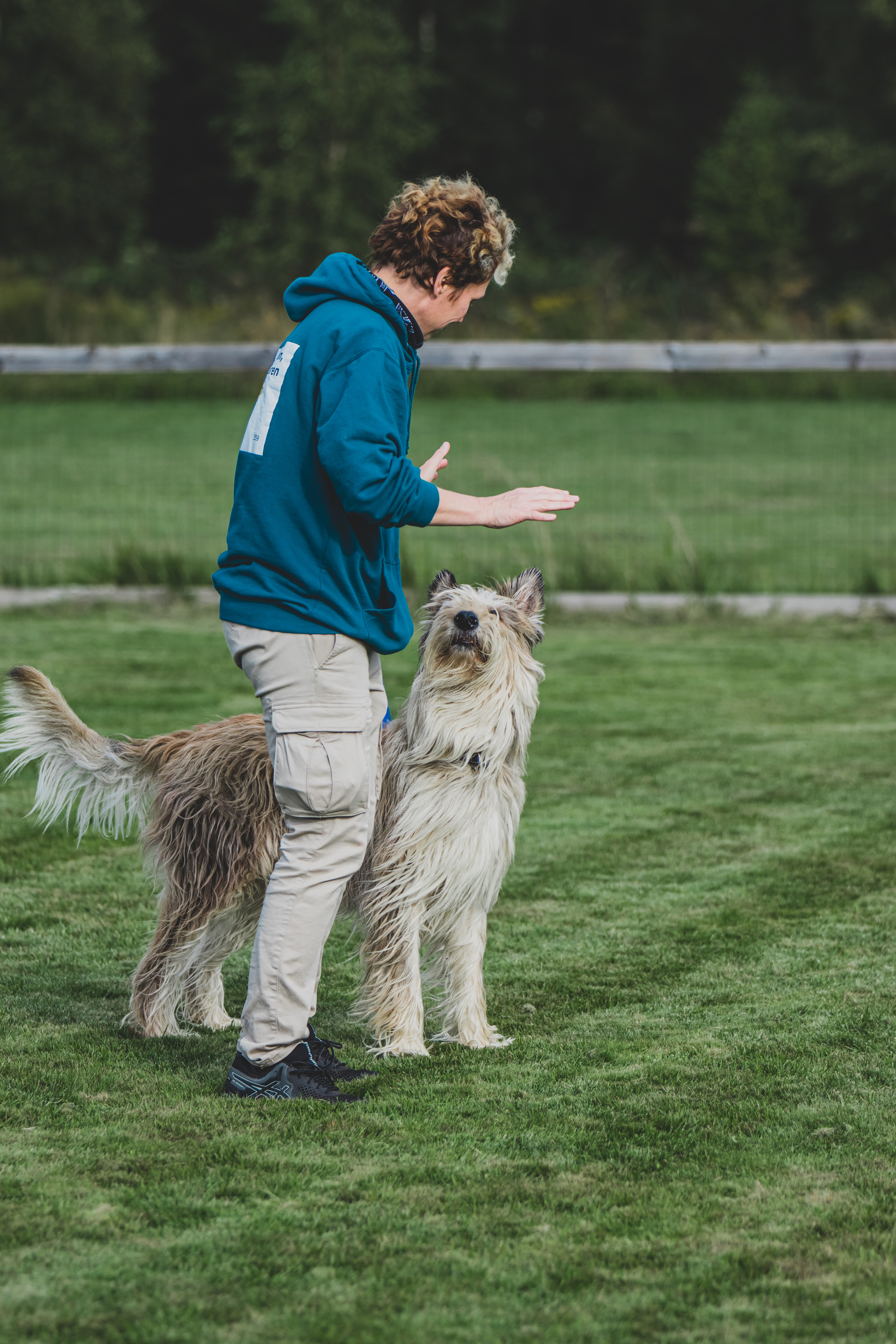
This started out as an exercise for freestyle and rally obedience, but I nowadays put a little more effort into it, because sidesteps are great physio for dogs, too. Other than in competitions I use sidesteps quite a lot to steer Moril accurately in everyday life, when there’s very little space for a large dog or when I need him to point in an exact direction. That happens quite often in my classes, when a reactive dog is training to look at other dogs. Instead of walking right up to the dog I can place Moril at an exact angle to keep the other dog calm, but we can still approach step by step. But the shining moment of sidesteps comes of course when Moril occupies my side of the sofa and needs to move. :-)
What uncommon signals do you have that are really useful?
Thanks for reading Jana’s thoughts on dog training! Subscribe for free to receive new posts and support my work.